Legends of Santa Claus and Christmas Customs
Legends of Santa Claus & Christmas Customs
The customs which we celebrate in America for Christmas, which means “Christ’s Mass,” come from a number of countries. Santa Claus himself comes from a Dutch Bishop, Saint Nicholas, who brought presents to the needy and the young, and was brought to the New World by, among others, Columbus, who named a Haitian port for St. Nicholas in 1492, and by the Spanish, who named what is now Jacksonville, Florida, St. Nicholas Ferry.
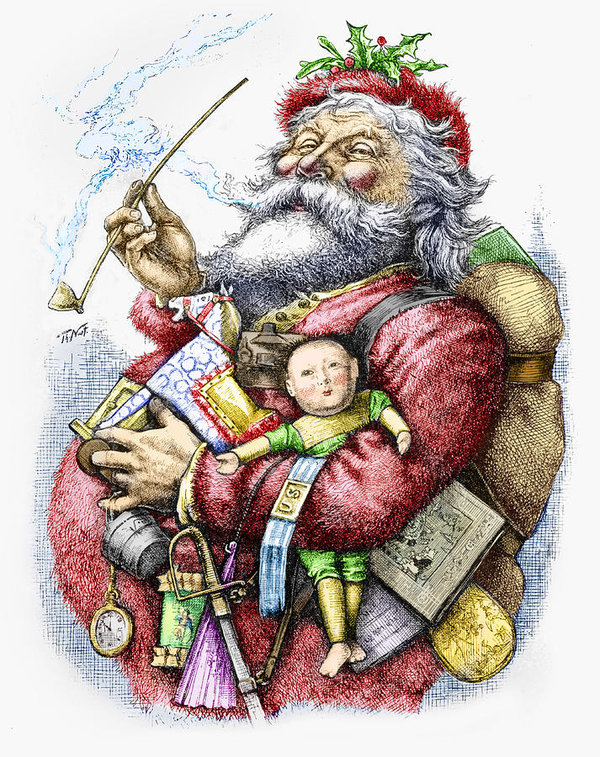
However, it was New Year gift giving, which began in England as early as 1558, that was the custom in America until the early 19th century. It took New Yorker Washington Irving, of The Legend of Sleepy Hollow & Rip Van Winkle fame, to popularize St. Nicholas and his image as a jolly, rotund figure, through a satire published in 1809. Still, the image of the gift-giving Santa Claus developed slowly, assisted by Thomas Nast, the famous American artist who, during the Civil War, portrayed Santa Claus as a Union supporter and rotund fellow with a long beard, dressed in red fur garments.

Even as late as the early 20th century, Santa Claus was still often referred to as St. Nicholas, and only after Coca Cola’s 35-year commercial use of Santa Claus in advertisements during the mid-1900’s was he established firmly in American culture. Norway is supposed to have given us the custom of Santa Claus coming down the chimney. One legend has St. Nicholas throwing gold coins down a poor family’s chimney, so his gift would be anonymous, and the coins landing in a stocking hung there to dry.
Pagan converts to Christianity used their sacred tree, the evergreen, to symbolize the holiday, and decorated the tree with candles, which represented the light that Christ brought to earth, and nuts. Mince meat pie, with its spices and fruits, symbolizes the exotic treasures of the three Wisemen. Icicle decorations are thought to symbolize the frozen tears of happiness coming from trees that realized that the child Jesus had taken shelter under their branches.
Finally, the Yule (wheel) log symbolizes the sun, which pagans thought stood still for 12 days at the end of each year; the log burns for 12 days to get rid of the evil of the previous year.
You can Track Santa Claus on Christmas Eve on NORAD.
Read Quarantine Christmas Ideas.
It’s Christmas Eve and what if Santa get the flu! Who else can deliver all the presents by Christmas morning? Mrs. Claus Saves Christmas
Share This Article!
About the Author: Yvonne Wonder